How Russia Uses Chemical Agents Against Ukrainian Military Personnel
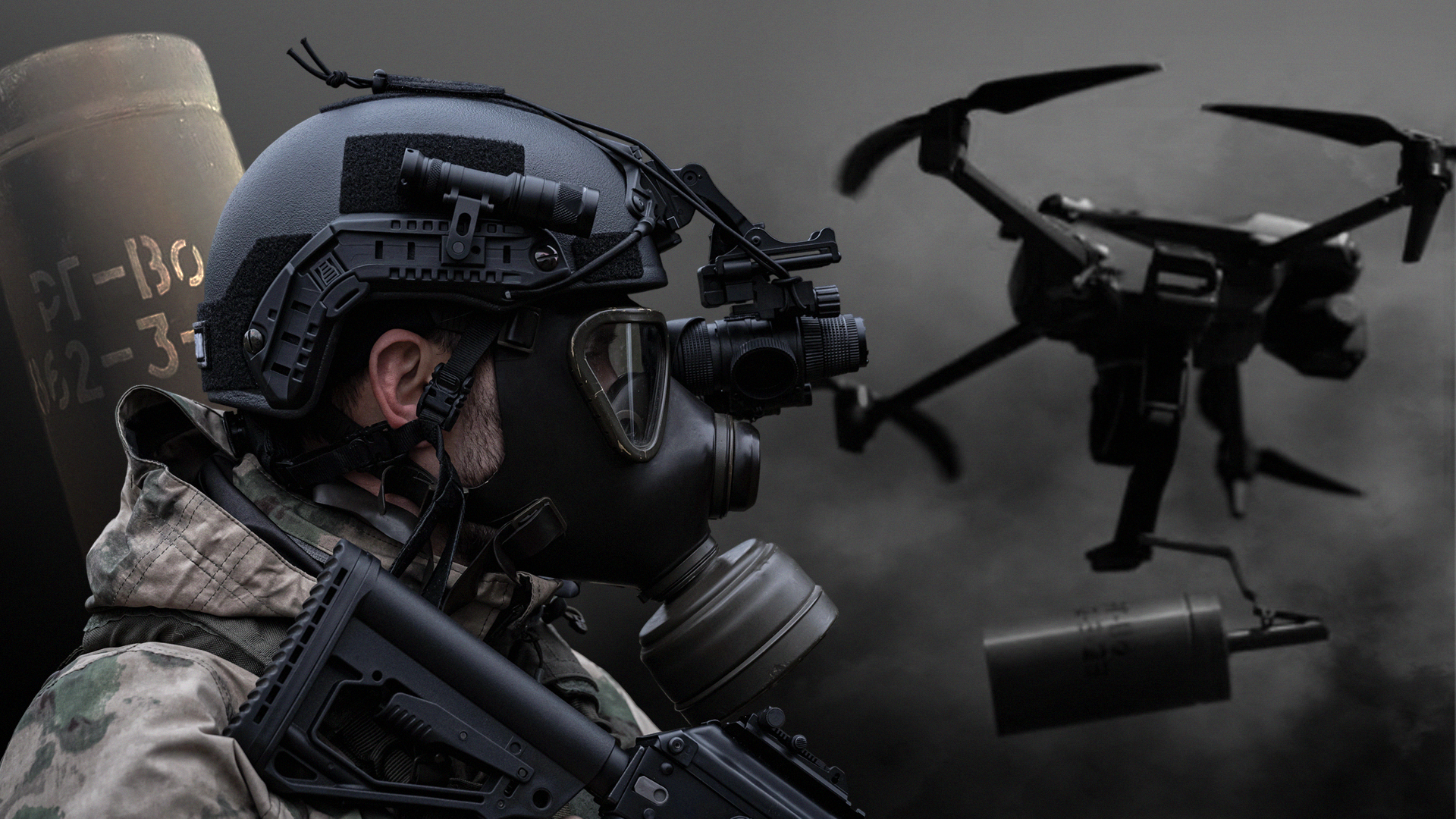
According to the General Staff of the Armed Forces of Ukraine (AFU), since the start of the full-scale invasion, more than 13,000 instances of the use of hazardous chemical substances against Ukraine’s Defense Forces have already been recorded. Specifically, this involves gas grenades containing CS and CN agents.
Recorded Incidents
On May 11, 2026, the 225th Separate Assault Regiment of the Armed Forces of Ukraine reported that Russian military personnel had dropped a gas grenade from a drone onto a dugout occupied by Ukrainian soldiers. The soldiers managed to evacuate the dugout in time, and evidence of the incident was handed over to competent authorities to be documented as a war crime. It was by no means an isolated incident. According to the General Staff of the AFU, since the beginning of the full-scale invasion, over 13,000 instances of Russian forces using hazardous chemical substances against Ukraine’s Defense Forces have already been recorded. In March 2026 alone, approximately 400 such attacks were documented. The highest intensity of use occurred in April 2025, when the Ukrainian military recorded 894 incidents within a single month. The General Staff notes that Russian forces systematically employ irritant agents alongside conventional means of fire battle. Specifically, this refers to K-51 and RG-Vo type gas grenades, which can be loaded with CS and CN agents.
CS stands for chlorobenzylidenemalononitrile—one of the most widely used irritant agents. CN stands for chloroacetophenone, an older type of tear-inducing agent. Both compounds can rapidly irritate the eyes, skin, and respiratory tract, temporarily disorienting an individual or forcing them to abandon cover. This is precisely why their use on the front lines is particularly dangerous. The U.S. Centers for Disease Control and Prevention (CDC) classifies CS and CN as “riot control agents"—chemical compounds that temporarily incapacitate a person by irritating the eyes, mouth, throat, lungs, and skin.
In March 2026, the Kharkiv Regional Prosecutor’s Office, in conjunction with the Security Service of Ukraine (SBU), issued notices of suspicion to nine servicemen belonging to the 136th Guards Separate Motorized Rifle Brigade of the Russian Army. They are suspected of employing means of warfare prohibited under international law. Specifically, the allegations concern the use of RG-Vo and K-51 chemical grenades against Ukrainian military personnel in the vicinity of the village of Tykhe, Kharkiv Oblast; these grenades may contain the irritant agents CS and CN. According to the investigation, the order to employ these chemical grenades may have originated from the brigade commander, Ruslan Nazarenko. Investigators link the organization and direction of the drone operators’ actions to the commanders of the reconnaissance units. At the same time, according to the case materials, the supply and preparation of these munitions were the responsibility of Alexander Kulikov, the head of the brigade’s Radiation, Chemical, and Biological Protection Service. Law enforcement authorities classify these actions as a violation not only of Ukrainian legislation but also of international norms—specifically, the provisions of the Fourth Hague Convention Respecting the Laws and Customs of War on Land and the Chemical Weapons Convention. In Ukraine, the suspects could face up to 12 years in prison under statutes regarding war crimes.
Russia has repeatedly employed phosphorus munitions. Such reports emerged as early as the beginning of the full-scale invasion: in March 2022, Pavlo Kyrylenko, head of the Donetsk Regional Military Administration, stated that such munitions had likely been used in Marinka, Krasnohorivka, and Novomykhailivka; subsequently, 11 wounded civilians—including children—were transported to a hospital. In November of that same year, Ukrinform, citing an SBU intercept, reported that a Russian serviceman had admitted during a conversation to using phosphorus munitions against Ukrainian forces in the Bakhmut area. The danger of such weapons lies in their incendiary effect: white phosphorus can trigger large-scale fires and cause severe injuries, and its use in populated areas or against civilian populations may constitute a violation of international humanitarian law.
How is the world reacting?
In 2024-2025, the Technical Secretariat of the Organization for the Prohibition of Chemical Weapons (OPCW) conducted three technical assistance visits to Ukraine. According to the organization, the findings of all three reports confirmed that samples collected by the Ukrainian side on the battlefield contained the toxic chemical substance CS.
Additionally, the Associated Press reported that Dutch and German intelligence agencies have concluded that Russia’s use of prohibited chemical agents in Ukraine has become not merely sporadic, but systematic. According to their assessments, the use of such substances has become “standardized and routine” for Russian troops. This refers, in particular, to the use of chloropicrin and CS against Ukrainian military personnel situated in trenches, dugouts, or other shelters. Russia, for its part, has previously denied using chemical weapons.
In May 2025, the Council of the EU imposed additional restrictive measures against three units and institutions within the Russian Armed Forces. The sanctions list included the Radiation, Chemical, and Biological Protection Troops; the 27th Scientific Center; and the 33rd Central Scientific Research and Testing Institute of the Russian Ministry of Defense. The basis for this decision lay in reports by the Organization for the Prohibition of Chemical Weapons, published in November 2024 and February 2025. These reports confirmed that riot control agents—specifically CS and related compounds—were detected in samples collected along the front line in Ukraine. The Council of the EU’s decision noted that Russia had failed to provide a credible explanation for the widely reported use of riot control agents. Against this backdrop, the European Union urged the OPCW to promptly establish accountability for the proven instances in which such substances were used as a method of warfare.
What does international law say?
The Organization for the Prohibition of Chemical Weapons explains that the Chemical Weapons Convention prohibits the use of riot control agents as a method of warfare. This is explicitly stipulated in Article I, Paragraph 5 of the Convention: States Parties are obliged not to employ such substances as weapons on the battlefield. This refers to chemical agents that, in peacetime, may be used by law enforcement agencies—for instance, for crowd control. However, in combat situations, their legal status changes. If such substances are employed against military personnel during hostilities, they are no longer regarded as “police tools.” Instead, they are classified as chemical weapons, the use of which is prohibited under international law.
Article II, Paragraph 7 of the Convention defines a riot control agent as any chemical substance that is not listed in the specific schedules of prohibited substances but is capable of rapidly producing sensory irritation or temporarily incapacitating an individual. Such effects typically subside shortly after exposure to the substance ceases. It is precisely this category that includes the irritants commonly used in tear gas grenades.
At the same time, the Convention requires States Parties to declare all toxic chemical substances in their possession that are intended for riot control purposes. This requirement is essential for international oversight, ensuring that such agents do not evolve into instruments of warfare. Consequently, any instances of their use on the front lines necessitate a separate investigation, expert analysis, and legal assessment.
