Without food, water, or a way out: Russia’s responsibility for the situation in Oleshky
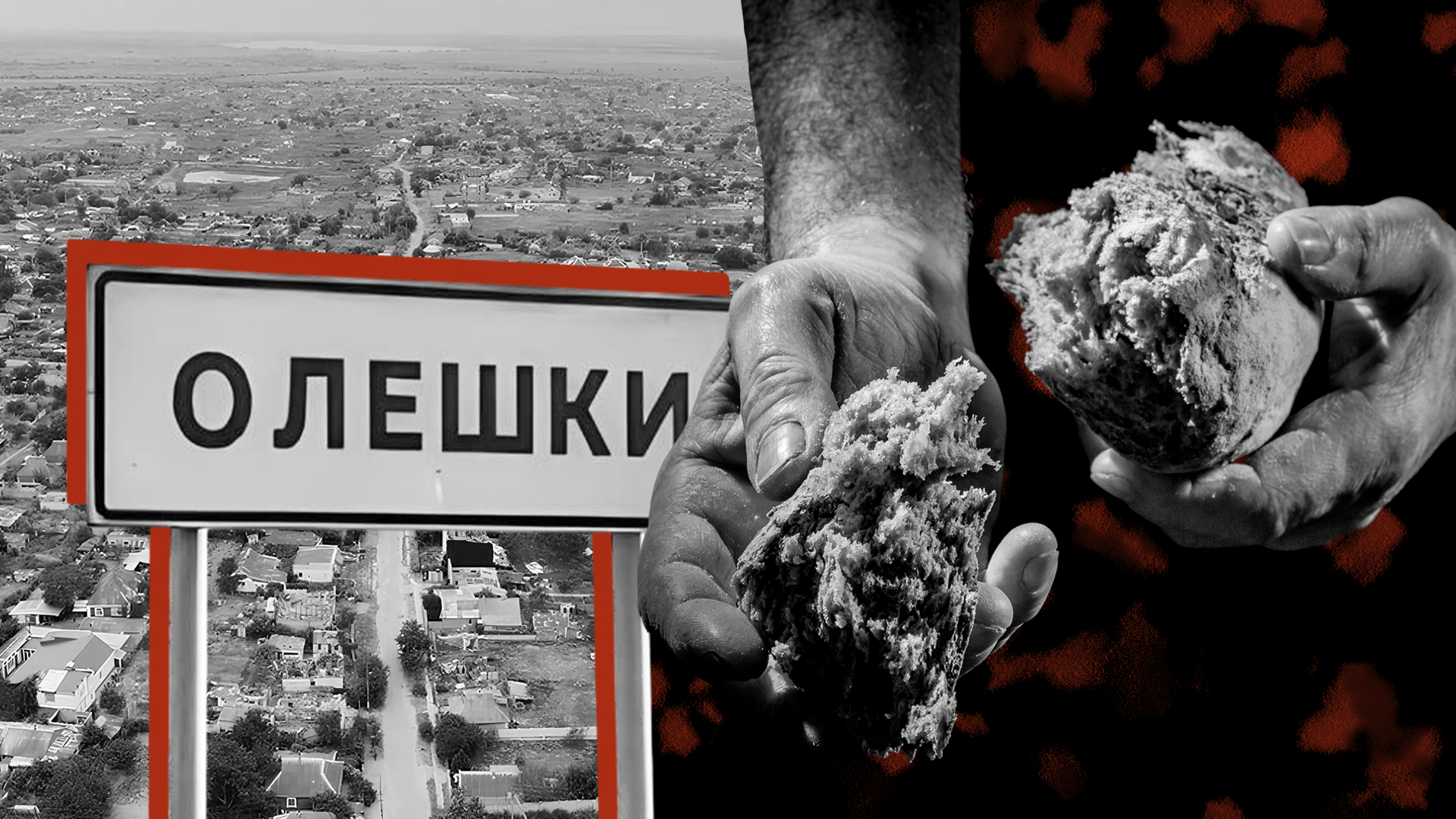
International law obliges Russia to provide the civilian population with basic necessities. We examine the occupying power’s responsibilities and determine when depriving people of food and water constitutes a war crime.
What life looks like in Oleshky
In occupied Oleshky in the Kherson region, food, water, and medicine have long ceased to be standard parts of daily life. According to Reuters, as of early October, approximately 1,700 people remained in the city, including 47 children. Reliable electricity, gas, and water supplies have stopped, and regular food deliveries effectively ended in late May.
Before the full-scale invasion, tens of thousands of people lived in Oleshky; now, a significant portion of the city is damaged, and those who remain are almost completely cut off from normal supply lines.
To get food, some residents have to travel to the neighboring town of Radensk. Locals have dubbed this route the “Road of Death”: it is riddled with mines, monitored by drones, and lined with the wreckage of burnt-out vehicles. A resident of Oleshky who managed to leave told “Suspilne” that vehicles trying to bring food into the city were blown up, so transporters stopped taking the risk. Reuters reported the case of a woman who traveled to Radensk for groceries in September and was killed by a landmine.
Those unable to leave survive on whatever supplies remain in their homes or what they have managed to grow. Locals told journalists they harvest vegetables and greens from their gardens, cook over open fires due to the lack of gas, and trade food among themselves. “Ukrainska Pravda” reported on a small, informal market near the hospital where shortages caused the prices of basic staples to skyrocket: a carton of ten eggs cost up to 800 hryvnias, while potatoes or onions went for around 500 hryvnias. Some people have also resorted to wild greens and whatever else they can find because standard food supplies are scarce.
The hospital remains one of the few places in the town still trying to help people, yet it suffers from shortages of medicines, antibiotics, equipment, and generator fuel. Volunteers in contact with residents said that staff ask people to bring grains and other food items to prepare at least simple meals for bedridden patients. “Suspilne” also reported that victims of drone attacks sometimes have to make do with basic first aid because comprehensive medical treatment is unavailable locally.
According to sources speaking to “Suspilne”, eleven people attempted to leave Oleshky on foot in early September, but their subsequent fate remains unknown. Ukrainian Ombudsman Dmytro Lubinets said the Ukrainian side proposed organizing a civilian evacuation, but Russia did not agree.
In late September, they delivered about four tons of humanitarian aid to 100 locations across the town in cooperation with the Kherson Regional Military Administration. However, even receiving such aid entails risks for the residents. Tetiana Hasanenko, head of the Oleshky City Military Administration, told Ukrinform that Russian troops were seizing food supplies delivered to residents. According to her, having food not produced in Russia could be grounds for accusations of “collaboration with the Armed Forces of Ukraine.” Oleksandr Prokudin, head of the Kherson Regional Military Administration, also reported instances of people being detained and beaten after receiving such aid packages, as well as cases where Russian forces shot down drones carrying food and appropriated the aid for themselves.
In late September, Council of Europe Commissioner for Human Rights Michael O’Flaherty also called for ensuring humanitarian access and the possibility of safe departure for the population. While the Russian side acknowledged that the supply situation in Oleshky was critical, it blamed Ukraine for the problems and claimed that Russian troops were attempting to assist residents. Ukraine, conversely, accuses Russia of blocking normal supply lines and evacuations. Regardless of how the opposing sides explain the causes of the crisis, the fact remains: people in territory controlled by Russia for several years have been living for months without reliable access to basic necessities.
Russia’s obligations under occupation
International humanitarian law imposes specific obligations on an occupying power regarding the civilian population in occupied territory. It is required to ensure the provision of food and medicines, maintain the functioning of medical services and proper sanitary conditions, and guarantee access to resources essential for survival. While hostilities may complicate supply efforts, they do not absolve the occupying authorities of these obligations. Article 55 of the Fourth Geneva Convention states this. If an occupied territory lacks food and medical supplies, the occupying power must organize their importation.
Article 56 specifically addresses healthcare: occupying authorities must maintain hospitals and medical services and ensure public health and sanitation. If the centralized water supply is destroyed or ceases to function, the authority controlling the territory must organize an alternative water supply or facilitate its delivery. Additional Protocol I to the Geneva Conventions also addresses other items essential for civilians—such as clothing, bedding, shelter materials, and other necessities. Depending on the specific circumstances, this may also include heating fuel.
When local resources are insufficient, Article 59 of the Fourth Geneva Convention applies. It provides for humanitarian operations for a population lacking essential supplies; the occupying power must consent to such aid and facilitate its delivery. While it may inspect shipments, coordinate routes, and impose reasonable security requirements, it must not use these procedures to block aid. Article 60 explicitly establishes that supplies provided by humanitarian organizations or other parties do not absolve the occupying power of its responsibilities.
When food and water shortages during occupation may constitute a war crime
A shortage of food and drinking water in an occupied territory does not, in itself, prove that a war crime has been committed. Hostilities, road damage, landmines, or infrastructure destruction may interrupt supplies. However, international humanitarian law also considers how the occupying power acts under such conditions: whether it tries to provide the population with necessities, uses available resources, and allows humanitarian aid. In its commentary on Article 55 of the Fourth Geneva Convention, the International Committee of the Red Cross (ICRC) explains that occupying authorities must use all available means to meet the population’s basic needs. This encompasses organizing transport, planning supplies, and taking other necessary measures. In paragraph 3448 of the commentary, the ICRC emphasizes that planning deficiencies cannot justify a shortage of vital resources.
The longer a state controls a territory, the more measures may be required to provide for the population. Under certain circumstances, it must organize food production and delivery rather than merely distributing existing stocks. At the same time, international law acknowledges the challenges associated with hostilities. Therefore, it is important to determine what capabilities the occupying authorities possessed and whether they utilized them.
If a state cannot provide for the population on its own, it must consent to humanitarian aid and facilitate its delivery. This is stipulated in Article 59 of the Fourth Geneva Convention. Occupying authorities may inspect shipments and coordinate routes but must not create unreasonable obstacles. In paragraph 3578, the ICRC commentary notes that such actions may constitute an unlawful denial of humanitarian access.
Failure to fulfill these obligations may entail the state’s international legal responsibility, even in the absence of evidence of the intentional use of starvation as a method of warfare. According to Articles 1 and 2 of the UN International Law Commission’s Draft Articles, a breach of an international obligation may consist of either an action or an omission by the state. At the same time, international law specifically prohibits the use of starvation of the civilian population as a method of warfare. Article 54 of Additional Protocol I to the Geneva Conventions prohibits the intentional deprivation of the means of survival—specifically, the destruction or rendering useless of food supplies, drinking water sources, and water installations—for the purpose of denying civilians essential resources. This prohibition also applies when such actions are intended to force people to leave an area.
The intentional use of starvation of civilians as a method of warfare is defined as a war crime under Article 8(2)(b)(xxv) of the Rome Statute. This can also encompass the intentional obstruction of humanitarian aid delivery. However, to establish such a classification, it must be proven that a specific individual deprived civilians of resources essential for survival with the specific intent of using starvation as a method of warfare.
In Oleshky’s case, it is crucial to determine what capacity the Russian occupation authorities had to provide for the population and what actions they took. Russia has controlled the city since 2022, yet food and water shortages became particularly acute in 2026. As early as June 25, the UN Human Rights Monitoring Mission in Ukraine reported that regular supplies of food deliveries to Oleshky ceased on May 26. UN representatives also documented reports regarding the threat of mines, drone attacks, difficulties with evacuation, and a lack of medical assistance. Even then, international observers reminded the occupying power of its obligation to provide the population with necessities.
To determine whether violations occurred, it is necessary to assess whether the Russian administration could have organized alternative supply routes, ensured medical facilities operated, or permitted the delivery of humanitarian aid. It is also important to determine who made decisions about access to the city, what restrictions were in place, and whether they could have been overcome. The mere absence of supplies does not prove intentional starvation; however, failing to fulfill obligations when opportunities existed to assist the population could violate international humanitarian law. Liability in such cases can arise at various levels. Russia, as a state, may be held accountable for breaching international obligations, while specific representatives of the occupation administration or military command could face criminal liability if their involvement in the relevant crimes—and the fulfillment of other necessary legal conditions—is proven.
Thus, the situation in Oleshky requires assessing the extent to which Russia is fulfilling its obligations as an occupying power. Establishing the war crime of the intentional use of starvation requires additional evidence regarding the specific actions and intent of the individuals involved. However, even if such intent cannot be proven, Russia is not absolved of liability under international law. The decisive factor is whether the occupation authorities had a genuine ability to provide the population with food, water, and humanitarian aid, and whether they took the necessary measures to do so.
