How Russia is Destroying Museums in Ukraine
![[музеї_обкладинка]](https://t4pua.org/files/img/1604924336.png)
During four years of full-scale war, Russian aggression has caused significant damage to Ukraine’s cultural heritage. Specifically, as of February 24, 2026, the T4P war crimes database contains 4,357 cases that meet the legal definition of “damage or destruction of historical monuments, hospitals, religious buildings, educational institutions, science, and art” (Article 8(2)(b)(ix) of the Rome Statute).
The direct losses to Ukrainian culture amount to approximately $4.2 billion, and the total losses to the cultural sector, including lost revenue, exceed $31 billion.
The Hague Convention Respecting the Laws and Customs of War on Land of 1907 and the First Additional Protocol to the Geneva Conventions of 1977 for the Protection of Victims of War require the protection of cultural property, even in times of war. And in 1954, the Hague Convention for the Protection of Cultural Property in the Event of Armed Conflict was adopted separately.
Despite this, Ukrainian museums continue to be damaged as a result of the full-scale Russian invasion. Here are some examples.
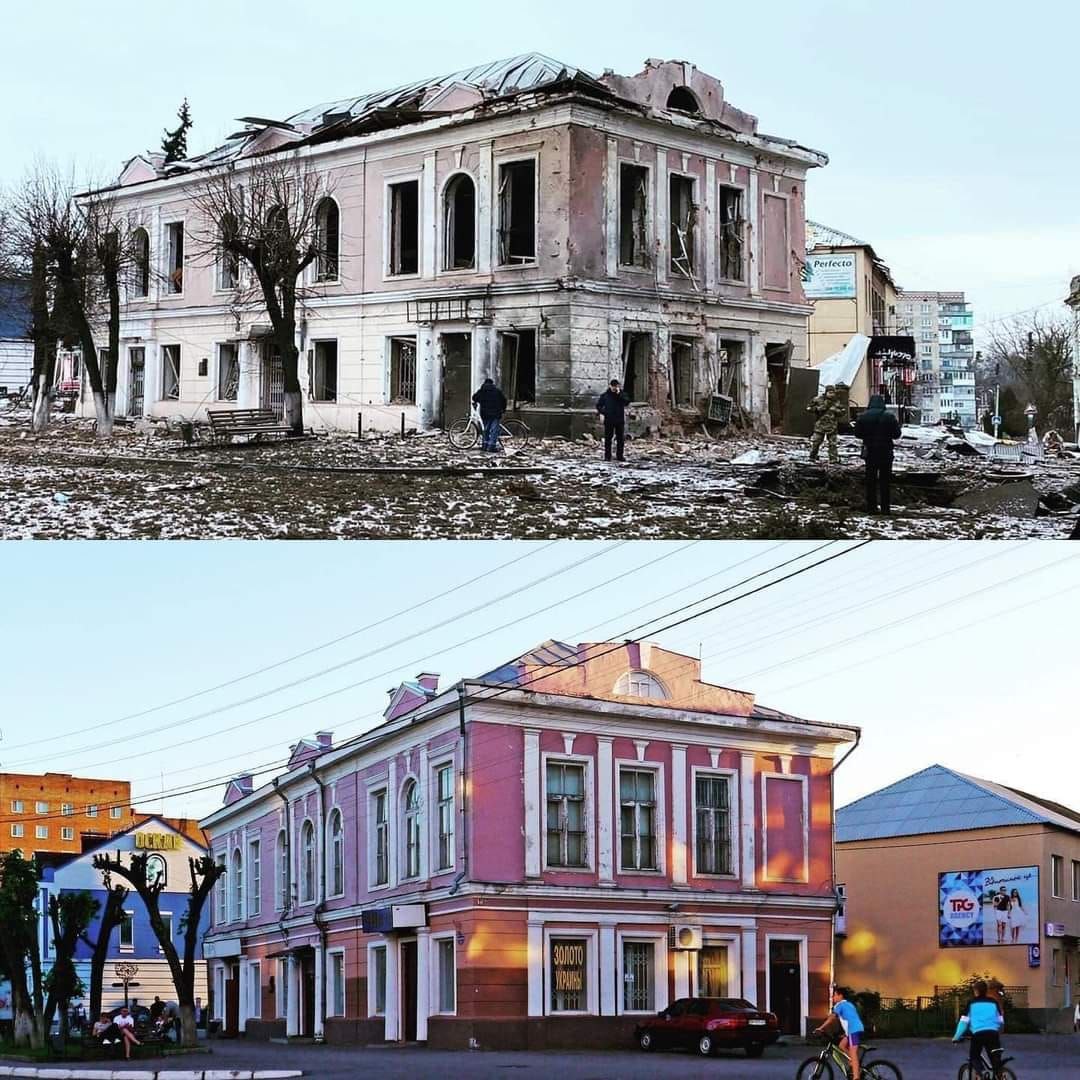
Okhtyrka Local History Museum
The Okhtyrka Local History Museum was one of the first museums in Ukraine to suffer destruction as a result of the full-scale Russian invasion. The building was damaged on the night of March 7-8, 2022, during the bombing of Okhtyrka, as reported at the time by Dmytro Zhyvytsky, head of the Sumy Regional Military Administration.
In 2021, the institution celebrated its 100th anniversary. According to museum director Lyudmila Mishchenko, the collection at that time numbered approximately 350 items. In 2024, Suspilne reported that the damaged building was preserved with grant funds, and the exhibits were moved to temporary premises. Its location is not disclosed for security reasons.
Arkhip Kuindzhi Art Museum, Mariupol
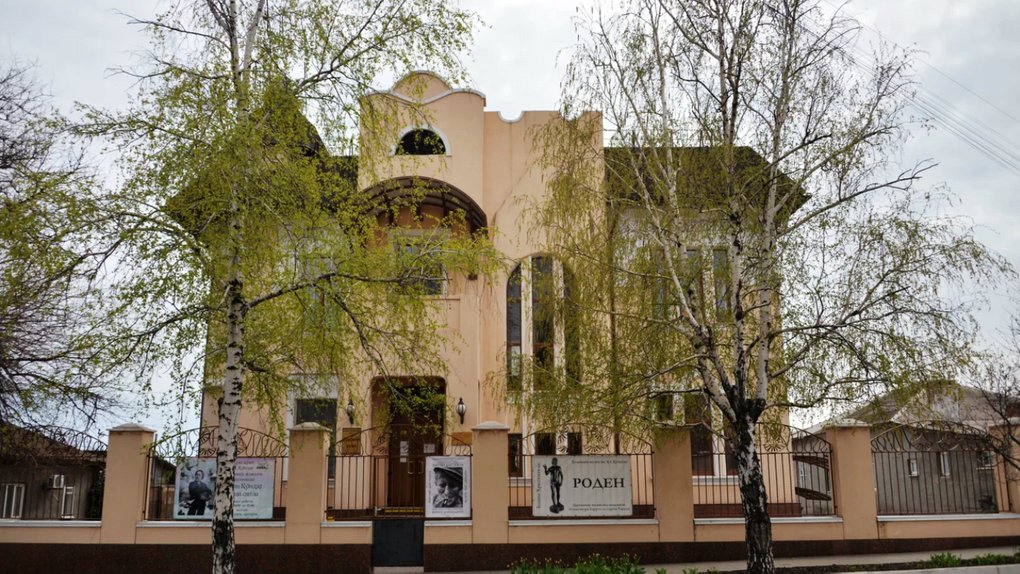
On March 21, 2022, the Arkhip Kuindzhi Art Museum was destroyed during Russian shelling in Mariupol. Kostyantyn Chernyavsky, Chairman of the National Union of Artists of Ukraine, noted in a commentary to Local History that at the time of the bombing, the museum did not house any original works by Kuindzhi; only copies by Andriy Yalansky and Oleksandr Olkhov were on display. However, works by other renowned Ukrainian artists were also housed there. Before the war, the museum’s collection contained approximately 2,000 exhibits, ranging from paintings and decorative and applied arts to graphic art and sculpture.
The Kuindzhi Museum opened in 2010 in the so-called “Geotsintov Estate,” a building dating from 1902. Vasyl Geotsintov is known in Mariupol as a philanthropist and founder of the Mariupol Real School.
Local History Museum in Ivankiv, or the Primachenko Museum
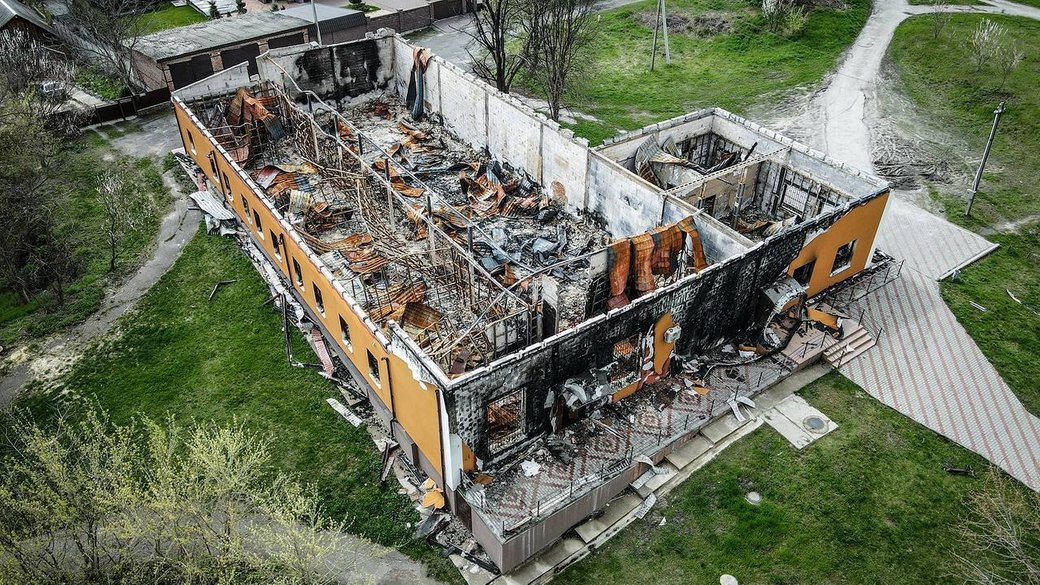
On February 28, 2022, in Ivankiv, Kyiv Oblast, the local history museum, which housed works by the world-renowned Ukrainian folk artist Maria Primachenko, burned down as a result of shelling by Russian troops. The regional prosecutor’s office reported the fire and destruction. The museum’s collection contained approximately two dozen of her works. Museum staff and residents managed to save some of the works.
After the building’s destruction, the museum found a “second life” in digital form. In particular, the Ministry of Culture and Information Policy of Ukraine announced that a 3D tour of the Maria Primachenko Museum is available—a virtual excursion created in 2022.
Koenig Estate, Trostyanets
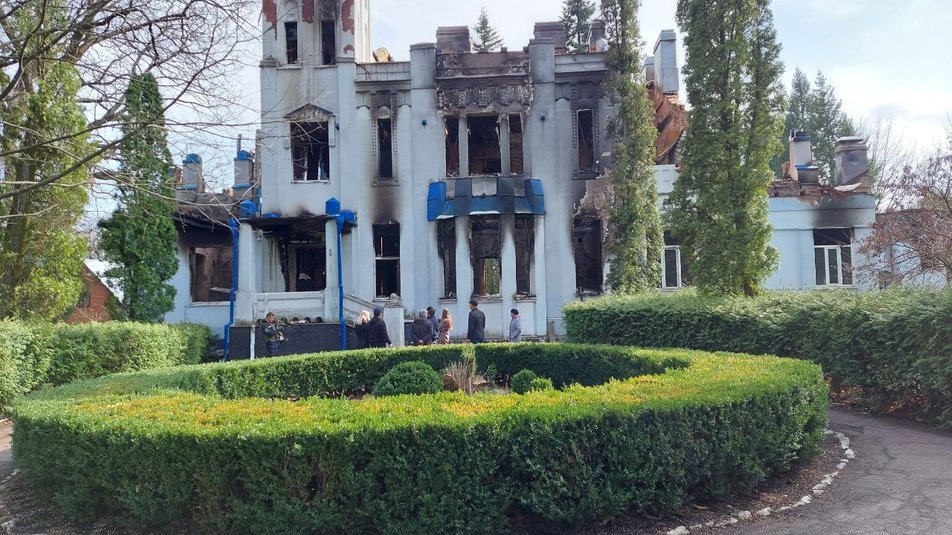
On the night of February 23-24, 2022, Trostyanets was hit by artillery shelling. As a result, the Koenig Estate (also known as the Golitsyn House) — a 19th-century historical and architectural monument of national significance, listed in the National Register of Immovable Monuments of Ukraine — was damaged.
The estate was owned by Prince Vasily Golitsyn for almost half a century, from 1832. In 1881, the estate was transferred to sugar manufacturer Leopold Koenig, who reconstructed the building. Before the war, the Trostyanetsky Museum and Exhibition Center operated here, including the Pyotr Tchaikovsky Memorial Room and the Chocolate Museum, which opened in 2012 in the palace’s left wing.
According to the center’s director, Yevgeny Malovichko, the wing housing the local history exhibit suffered the most damage, and there is also damage inside the building. According to preliminary expert estimates, the restoration of the monument will require tens of millions of hryvnias.
Hryhoriy Skovoroda Museum, Skovorodynivka
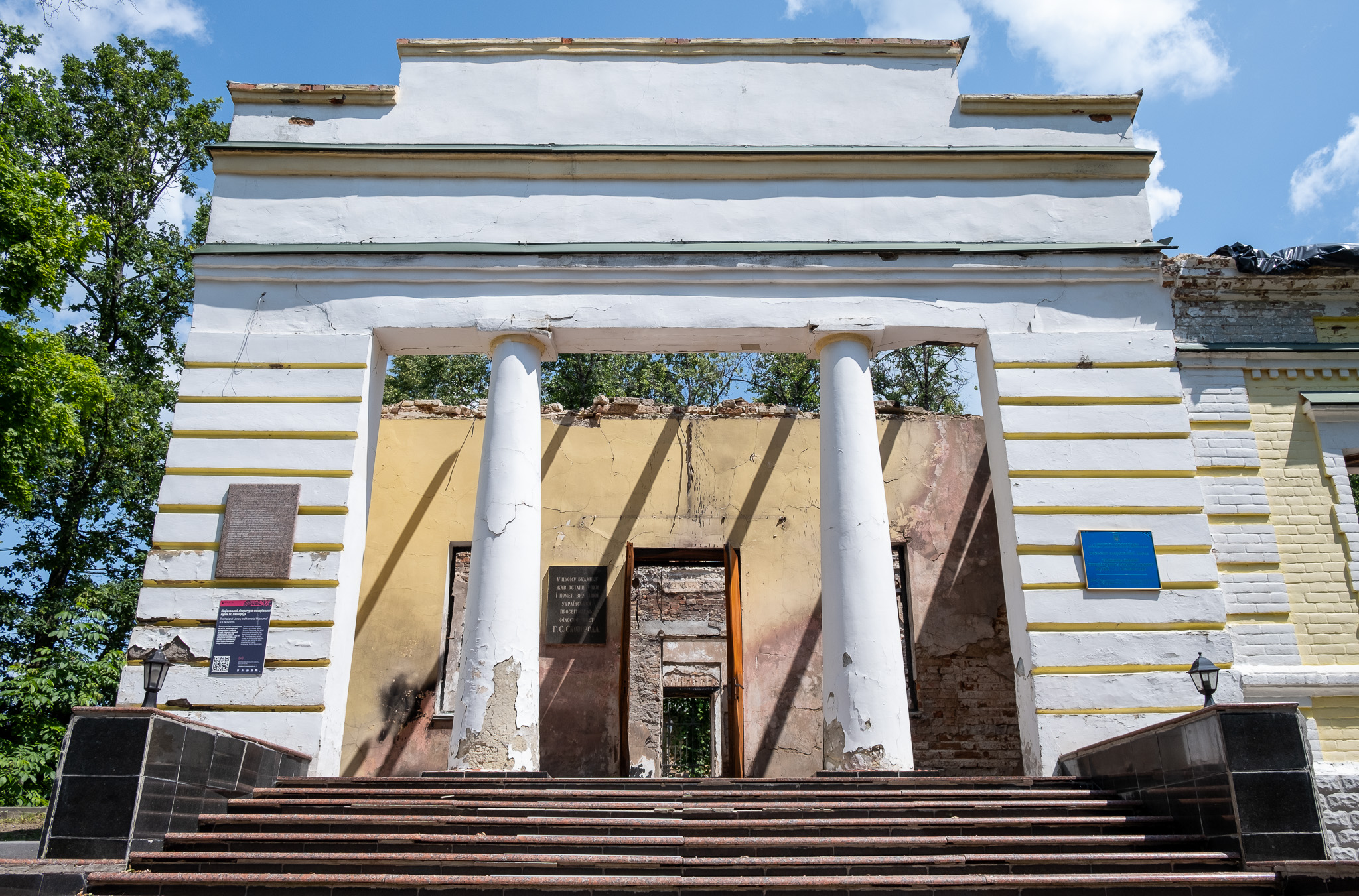
On the night of May 7, 2022, during a shelling attack, Russian troops destroyed the Hryhoriy Skovoroda National Literary and Memorial Museum in the village of Skovorodynivka in the Kharkiv region. The Zolochiv Village Council reported the attack on Facebook. The museum is located in the former estate of the Kovalevski landowners. It was here that Hryhoriy Skovoroda spent the last four years of his life, from 1790 to 1794.
After the missile hit, a fire broke out in the building. The fire destroyed approximately 280 square meters. At the same time, the most valuable exhibits were saved: some of the collection was evacuated beforehand, while others were evacuated after the fire broke out.
On July 4, 2024, the Security Service of Ukraine announced the completion of evidence collection and the issuance of a notice of suspicion to Ivan Panchenko, commander of the 159th Fighter Aviation Regiment of the Western Military District of the Russian Armed Forces. According to the investigation, it was on his orders that a Su-35S fighter jet fired a Kh-35 turbojet anti-ship missile at the museum complex.
Despite significant damage, experts believe the building can be restored. On November 30, 2023, the Regional Municipal Institution “G.S. Skovoroda National Literary and Memorial Museum” signed an agreement with the Ukrainian State Research and Design Institute “UkrNIIProektrestavratsiya” to develop a design and estimate for the restoration of the house where the philosopher lived. The cost of this work is 3.44 million hryvnias.
Kupiansk Museum of Local History
On April 25, 2023, Russian troops twice struck the building of the Kupiansk Museum of Local History, effectively destroying it. According to Olga Soshnikova, director of the Kharkiv Historical Museum, before the full-scale war, the Kupiansk Museum of Local History was one of the most powerful in the Kharkiv region and served as an important cultural center for the city.
After the full-scale invasion in 2022, the Kupiansk Museum of Local History fell under Russian occupation. Director Iryna Osadchaya, who later died during the shelling of the museum, managed to preserve some of the most valuable exhibits. In particular, she, along with concerned city residents, distributed and hid antique Ukrainian shirts in various households to protect them from destruction or theft.
After the deoccupation of Kupiansk, part of the main collection was evacuated for storage to the Kharkiv Historical Museum. In total, the Kupiansk Museum’s collection contained over a thousand items.
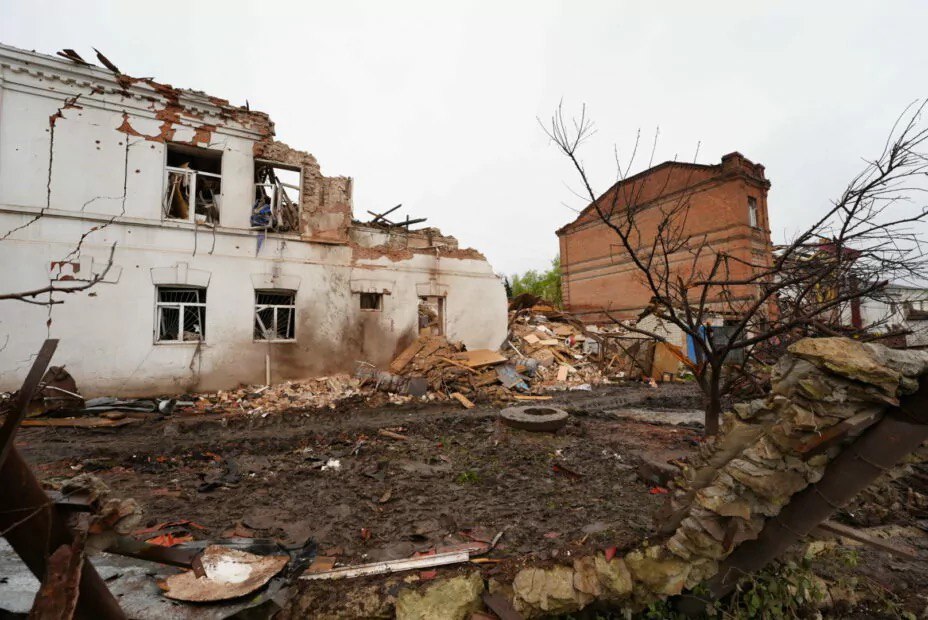
The above are just a few of the documented cases. The destruction of Ukrainian museums continues.
