Double Crime
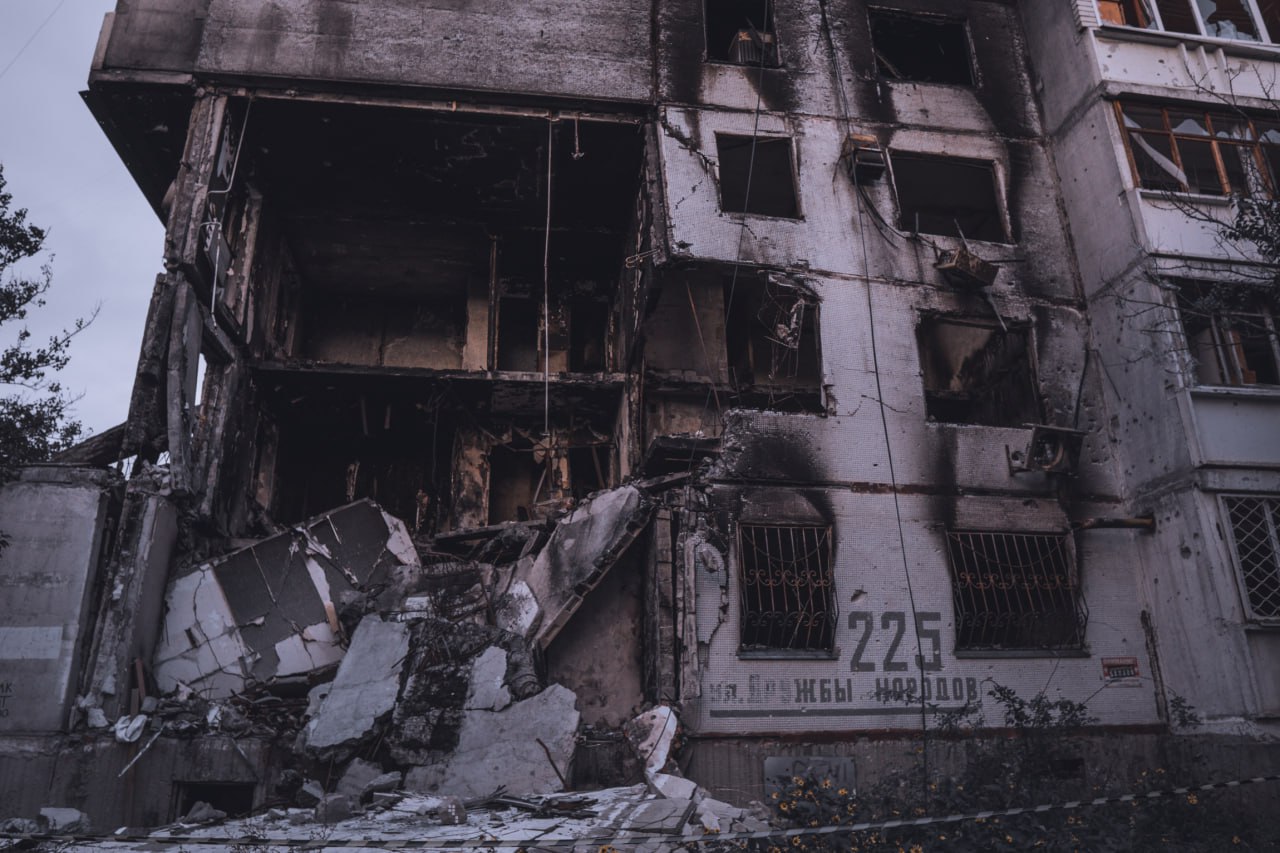
In 2026, Russian occupation forces intensified attacks on Ukraine’s energy infrastructure, particularly against the backdrop of deteriorating weather conditions and the onset of cold weather. On January 5, the city of Kharkiv was attacked with five missiles from the “Tornado-S” multiple rocket launcher system. The target of the occupiers was once again an energy facility located in a densely populated area. This was not the first use of this type of weapon. Still, it was at the end of 2025 and the beginning of 2026 that the Russians began using the “Tornado-S” significantly more actively, specifically in attacks on targets within the city of Kharkiv.
On December 24, 2025, at about 5:30 AM, the Russians shelled an energy facility using a Tornado-S in the suburbs of Kharkiv: one person died, and 13 others were wounded.
On September 24, 2024, the Russians shelled the Kyiv district of Kharkiv with a Tornado-S MLRS — there were no casualties.
On August 5, Kharkiv was shelled with the same MLRS; four people were wounded.
The multiple rocket launcher system was developed as a weapon that operates “over large areas” and covers significant territory with powerful explosive force, sometimes over hundreds of square meters. Despite modern MLRS being significantly more accurate than systems developed in the 1960s and 1970s, these systems still cannot be confidently called high-precision weapons, since their very principle of operation involves attacking large, wide areas. This fact is determined, in particular, by the position of the UN Office for Disarmament Affairs.
“Particularly problematic types of weapons include indirect fire weapons. Weapons that fire in salvos, such as multiple launch rocket systems (MLRS). Such systems include munitions with a large radius of destruction, weapons with inaccurate delivery systems, or weapons systems that deliver multiple munitions over a large area.
The main problem is the use of explosive weapons, particularly those with widespread destructive effects, in populated areas. Many of these weapons were initially designed for use on open battlefields and are inherently indiscriminate when used in populated areas, leading to increased civilian casualties and devastating humanitarian consequences,” the organization’s position states.
On December 20, 2024, Amnesty International analyzed the use of MLRS by the Hezbollah terrorist movement against targets in Israel. It concluded that the use of multiple launch rocket systems in urban areas is inherently a violation of international humanitarian law.
Although the Tornado-S multiple launch rocket system has been used against Ukraine since 2014, as evidenced by materials from the human rights organization IPHR, this weapon can still be considered rare, and data on its technical characteristics remain unverified.
According to the authoritative resource The Military Balance, as of 2021, Russia had only 20 such systems, and their use is isolated, which significantly complicates the analysis of their true characteristics.
On the afternoon of March 22, 2023, Russian troops fired six Tornado-S rockets at residential areas of Zaporizhzhia. One of the rockets landed between two residential buildings in a residential area of the city; Thirty-four people were injured, including three children. This is one example confirming that the “Tornado-S” cannot be considered a precision weapon, particularly in urban areas.
Russian official sources claim that the “Tornado-S” has significantly higher accuracy than its predecessors, such as the “Smerch” and “Uragan.” At the same time, even the official definition from the Russian Ministry of Defense emphasizes that the “Tornado-S” is “a system designed to strike any group targets at long range, the vulnerable elements of which are open and sheltered personnel, unarmored, lightly armored, and armored vehicles.” This description already indicates the principle of using the “Tornado” against group targets and troop concentrations.
Ukrainian energy facilities are historically located, among other places, in areas of dense urban development. This also applies to the city of Kharkiv. In such conditions, even a deviation of a few dozen meters can result in a direct hit on residential buildings or other facilities housing large numbers of civilians or visitors.
Thus, we are talking about a double crime. In addition to the very fact of attacks on Ukrainian energy infrastructure, which are a war crime, there is also the issue of the indiscriminate nature of the weapons used. These strikes use indiscriminate weapons, further endangering the civilian population, particularly the residents of Kharkiv.
Russia’s systematic attacks on energy infrastructure are classified as a war crime by the International Criminal Court. Back in 2024, the ICC issued arrest warrants for the commander of Russia’s long-range aviation, Sergei Kobylash, and the former commander of the Russian Black Sea Fleet, Viktor Sokolov, for crimes against humanity committed in connection with the shelling of Ukraine’s energy infrastructure.
Unfortunately, since then, attacks on energy infrastructure have not only continued but have become more widespread and destructive. As a result of the January 5 attack using “Tornado-S” missiles in Kharkiv, more than 350,000 customers were left without electricity, an event not related to the planned outages.
